1. The question everyone actually types
Somewhere around twenty-nine, you start hearing it. A friend says she's "going through her Saturn return." A singer you like turns it into a track. Someone on your feed posts about surviving theirs. So you open a search bar. And what you type isn't what is a Saturn return. It's almost always when is my Saturn return.
That's the real door into this idea. What people want first isn't the meaning. It's the timing. And the way the question gets asked says something about astrology itself.
Most of the time, astrology works like a map. It lays out the shape of the sky at the moment you were born, a picture you can read. A Saturn return sets a clock on top of that map. It asks about a moment, not a position: not where in the sky, but what time it is in a life.
2. One lap every 29.5 years
Saturn takes about 29.5 years to travel once around the Sun.
That single fact is where all of this starts. At the moment you were born, Saturn sat at some specific point in the sky. It has been moving slowly along the zodiac ever since, and after roughly 29.5 years it arrives back at the exact spot where it began. It returns, hence the name.
There's nothing mystical in the mechanism. It's the orbital period of a planet, worked out and counted. When Saturn comes back to that one point in your birth chart, astrology reads it as a transit: a moment when the moving sky lines up again with the chart you were born under. It's a matter of knowing a position, not divining one.
So the idea has coordinates. Not a vague mood, but a moment you can actually calculate.
3. So, when exactly
Start with the question that gets searched the most.
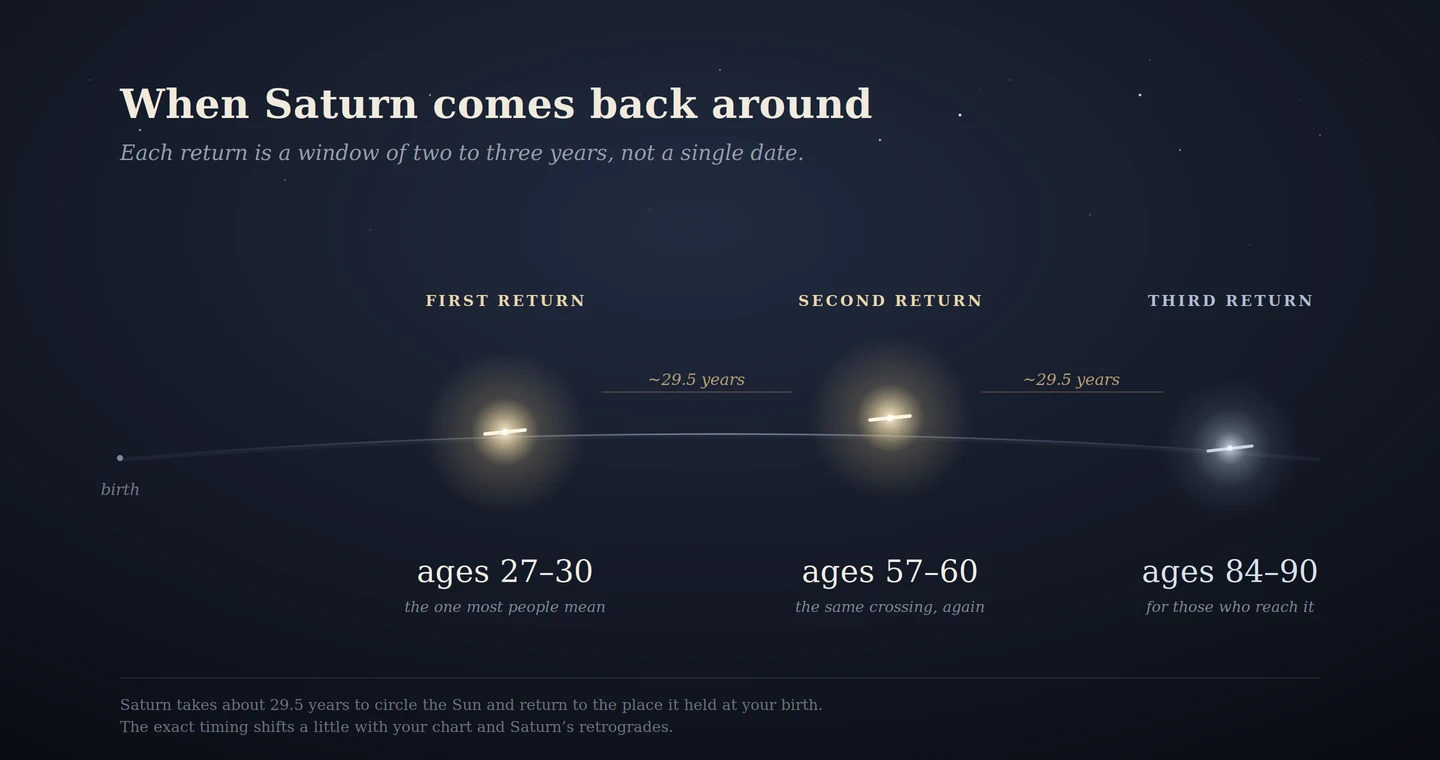
The first return lands somewhere between ages 27 and 30. This is the one nearly everybody means when they say "Saturn return." The second arrives around 57 to 60, and the third somewhere between 84 and 90, for those who live to see it.
Here's the part worth correcting right away. A Saturn return is not a single day.
If you came in hoping a search would hand you one clean date, that's a slightly deflating thing to hear. But Saturn moves slowly, and it goes retrograde along the way, which means it crosses the same point more than once. So it doesn't narrow down to one "return date." It tends to spread across a window of about two and a half to three years. Not a point, but a window.
If you want the exact degree, a known birth time makes it sharper. If you don't know your time, that's fine too. Roughly when it falls is something the birth year alone can place. The window is wide either way.
4. Why the late twenties, of all ages
This is where the more interesting question shows up. And the interesting part isn't that Saturn returns. It's that a life seems to come in phases at all.
Think about it without any astrology for a second. The late twenties really do tend to be when something shifts. School is finally behind you. Work either takes shape or comes apart. The relationships you're in start to carry real weight. People have noticed this stretch and named it for a long time, in plenty of languages that have nothing to do with planets.
What astrology does is put a coordinate on it. Saturn is the slow one, the planet read as structure, time, and limits, so astrology hands it the job of keeping the longer hours. And astrology doesn't read a life as one straight line. It reads it in cycles. The moment Saturn finishes a full lap and arrives back where it started becomes a mark, a line drawn between one stage and the next.
So the return isn't what creates the turning point. The turning point is something a lot of people feel anyway. The return is astrology's way of giving it a place on the map, a name and a time, instead of leaving it as a vague sense that something is changing.
5. The clock doesn't make the time
The most common misreading of a Saturn return is this: that bad things happen at that age.
It's true that jobs, breakups, moves, marriages, and big decisions tend to cluster between 27 and 30 for a lot of people. But that isn't Saturn making them happen. It's that those years are already when the structure of a life gets rebuilt once. School ends. Work either settles or shakes loose. Relationships start carrying weight.
What astrology does is put a name and a coordinate on that stretch. Not generate the events, but offer a frame for reading the change that's already underway. The same way a clock doesn't make time pass, it just lets you read what time it is.
That's why this is a question of resolution, not accuracy. A Saturn return doesn't tell you what will happen to you. It lets you see, a little more clearly than usual, which stretch of the line you're standing on.
What someone who typed when is my Saturn return actually walks away with isn't one date marked on a calendar. It's a way of reading roughly what hour it is in a life.